After the Gold Rush: Art Basel 2025 and the Quiet Rewriting of the Art World
At Basel, many gallerists aren't talking about success. They’re talking about management. Managing overhead. Managing burnout. Managing expectations. The vibe is clear: adapt or exit.

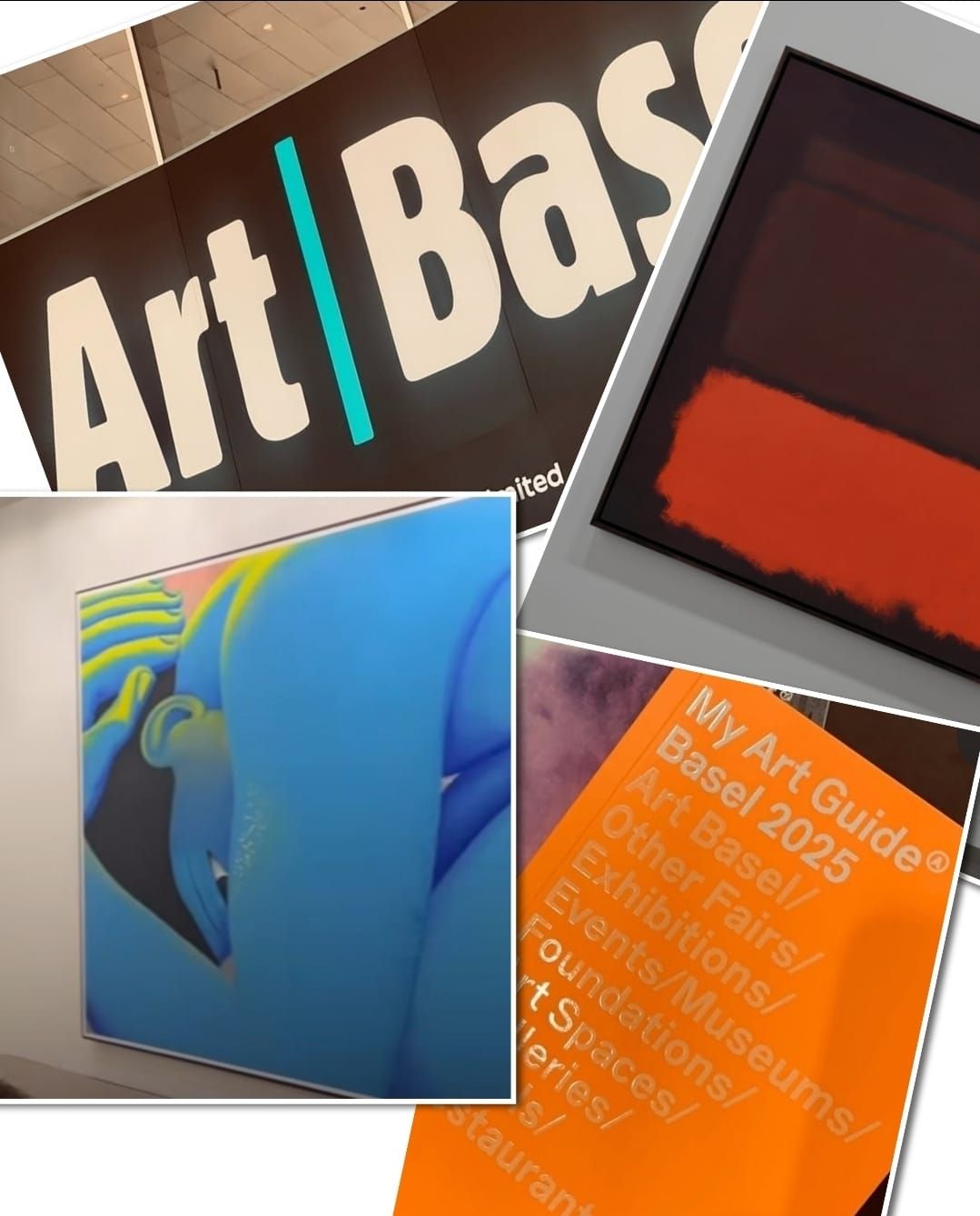
At ten in the morning, the Messeplatz is already a theatre of calculation. Art Basel 2025 opened not with a bang, but with the whisper of careful ambition. Booths were crisp, assistants rehearsed, collectors circling. Outside, the rain kept tourists at bay; inside, dealers were praying for a shift in gravity. No one’s calling it a recession, but everyone’s calling their banker.
It’s no longer a matter of headlines or headline sales. No $100 million Basquiat. No surprise Warhol find. The glamour hasn’t died - it’s just wearing more sensible shoes. Because while the market hasn't collapsed, it has slowed, and in its deceleration, something is changing. For the first time in a decade, the art world feels less like a circus and more like a system under review.
The biggest headline this year isn’t a sale - it’s a number. Global art sales declined to $57.5 billion in 2024, a 12% drop from the year before. That follows a previous decline of 3% the year prior. The free fall isn't vertical - but it’s prolonged. High-end sales, the prized blue-chip top of the auction pyramid, have plummeted. Works priced above $10 million saw a 45% decrease in value. Christie’s is down a third from its 2021 highs. Sotheby’s earnings dropped a stunning 88%. People are still buying. Just not like before.
And yet, paradoxically, things are moving down below. The under-$50,000 market - where younger collectors and emerging galleries play - is alive. It’s not just alive, it’s performing. Sales volume is steady, growing even. Galleries selling works under that threshold now account for nearly one-fifth of total value, and far more in pure transaction count. Less prestige, more persistence. It’s the middle and lower tiers that are, in effect, holding up the structure. And they're doing it not with record-shattering sales but with quiet, steady, sometimes desperate consistency.
At Basel, many gallerists aren't talking about success. They’re talking about management. Managing overhead. Managing burnout. Managing expectations. The vibe is clear: adapt or exit.
And adapt they are. One gallery from Seoul presented a booth of just four works - minimal, poetic, uncluttered. No price list, no QR codes. The gallerist told me they didn’t expect sales in Basel; they expected conversations. They’d already sold three of the four pieces weeks earlier during an online pre-sale preview. The booth was for prestige, not profit.
That split between spectacle and business is no longer theoretical. It’s strategy.
The structure holding it all together - sales, pricing, valuation - has also mutated. In the last 18 months, AI has slipped into the seat once reserved for the connoisseur. Not a robot in the corner, but something more banal and omnipresent: algorithms trained on decades of auction results, fair performance, artist career trajectories, Instagram reach. Platforms like Appraisal Bureau now offer automated art valuations with claimed 85% accuracy. Private banks use AI to guide portfolio acquisition and insurance strategies. Major fairs like Basel are quietly testing behavioral analytics to forecast foot traffic and collector interest.
In other words, the taste economy is no longer shaped only by critics, curators, or collectors. It’s shaped by code.
It’s not necessarily sinister. CRM tools now let galleries segment and track their collector base with forensic clarity. Artlogic, MyArtBroker, and similar platforms offer heatmaps of engagement, predictive sales prompts, valuation alerts. It’s not just “who clicked what.” It’s “who might buy what next week if nudged with a personal note.”
This new digital layer isn’t optional anymore. A dealer without infrastructure is a diner without a kitchen. There’s something exciting about it - this promise of data-enhanced clarity. But it also risks flattening taste. In the logic of algorithms, risk becomes inefficiency. Discovery becomes deviation. If machines learn from the past, they may struggle to imagine the future.
Some artists and institutions are resisting. Over 3,000 creatives signed an open protest this year against Christie’s AI-curated “augmented intelligence” auction. Their argument wasn’t just about credit. It was about context, labor, and the slow erasure of the human glitch - the unexpected, imperfect, unexplainable decision that once defined collecting.
Behind all this, of course, are the people holding the scaffolding together. And they’re tired.
According to a survey of over 300 galleries worldwide, 63% of respondents said running a gallery is harder now than two years ago. The reasons are no mystery: lower demand, rising costs, political instability. But the human toll is harder to quantify. Over half of employees in larger gallery teams reported burnout. One in four gallery owners admitted they too were burned out. Those numbers don’t come from drama - they come from accumulated exhaustion. International shipping costs are up. Rent is unpredictable. Museum shows, which used to generate sales, now often require funding from the gallery. Staff must run social channels, advise collectors, coordinate fairs, chase payment - all while curating. This isn’t business - it’s triage.
And yet they persist. Because the alternative - exit - means more than closing a space. It means ending a relationship with artists, cities, audiences. Most of the galleries reporting fatigue are also reporting hope. They’re investing in digital tools. They’re forming cooperatives. They’re programming fewer shows but spending more time on each. It’s not innovation at light speed - it’s survival through reinvention.
This weariness isn’t just personal. It’s geopolitical. 80% of galleries surveyed said political instability - tariffs, customs shifts, regulation - has made business harder. Art, once buffered from policy, is increasingly tangled in it. Brexit has decentered London. American trade tariffs complicate cross-border sales. Even shipping a sculpture from Berlin to Tokyo now invites layers of tax implications and paperwork that didn’t exist five years ago.
As a result, the geography of art is redrawing itself. Asian institutions and Middle Eastern collectors are rising. Southeast Asia is emerging not just as a market but as a curatorial hub. Western-centric narratives are no longer sufficient - or welcome. Galleries are adjusting accordingly, not just with translations and shipping lanes, but with programming that considers global complexity.
And perhaps that’s the quietest but most enduring change of all: the end of the singular story. For decades, the art world told one tale - a linear ascension from studio to gallery to fair to museum. Today, it’s a braided path: digital previews, online drops, community programming, NFT crossovers, mid-career retrospectives in Ghana, and residencies in Seoul.
Art Basel 2025 didn’t explode with energy. It pulsed with caution. There were sales - of course. There were parties - plenty. But there was also a recognition that something is over. Maybe not art. Maybe not collecting. But certainly the old operating system.
Even Le Quotidien de l’Art, in its post-fair debrief, noted a mood far more restrained than in 2024. The war-driven global climate and economic fog had clearly weighed on transactions. Some reports muttered about “less Americans, saving their euros for Paris,” or “a sluggish upper floor, penalized by booth position.” But these rumors - like the ones that swirl around Art Basel’s supposed “decline” - proved hard to verify, and often contradicted by what was actually on the walls.
Yet hard data doesn’t lie. Hauser & Wirth, the barometer booth for big-fair performance, announced €80 million in sales last year. This time, at the end of day one, they issued only an interim update: $25 million from around 30 works, including two Mark Bradfords ($3.5M each), a Frank Bowling ($1.8M), and two Avery Singers totalling $1.3M. Solid numbers, yes - but far from last year’s summit. Even the big fish seem to be swimming in a smaller pond.
So perhaps this is the reality: the fair is not dying, as some have claimed since the rise of its Paris sibling. But it is aging. And with age comes recalibration. Scale is less important than survival. Visibility matters more than velocity. The Basel of bombast has become the Basel of balance.
The post-pandemic gold rush is over. The next phase won’t be about more, faster, bigger. It will be about durability. Precision. Staying power. And perhaps, at long last, a bit of peace.