TEFAF 2026, Quality Is the Safest Currency

TEFAF Maastricht this year did not feel like a fair “outside the world.” It felt more precise than that: a place where the market, under pressure, retreats toward objects that can still command trust. That is different. In a moment marked by war, tariffs, political instability and general noise, TEFAF did not offer escape so much as concentration. The latest Art Basel and UBS report helps explain why. Global art sales rose 4% in 2025 to an estimated $59.6 billion, with the strongest push coming from the top end: public auction sales were up 9%, and works above $10 million rose about 30%. Fairs also regained importance, while online sales and social-media driven buying continued to reshape how collectors discover and acquire art. The market is not exactly relaxed. It is selective, digital, and increasingly polarized around quality and confidence.
That is why TEFAF matters. Not because it denies the world, but because it stages one very specific answer to it: if uncertainty grows, the premium on rarity, scholarship, condition and attribution rises with it. Some booths made that point better than others. Agnews, in both its London and Brussels dimensions, played a leading role for me. The London side drew attention with the so-called de Ganay Christ as Salvator Mundi, a version linked to Leonardo’s orbit and now one of the most discussed pictures in Maastricht. The work was shown with technical images, not just seductively hung, which is telling: at this level, argument and evidence are part of the spectacle. It is not enough anymore to present a painting. You also have to present the case.
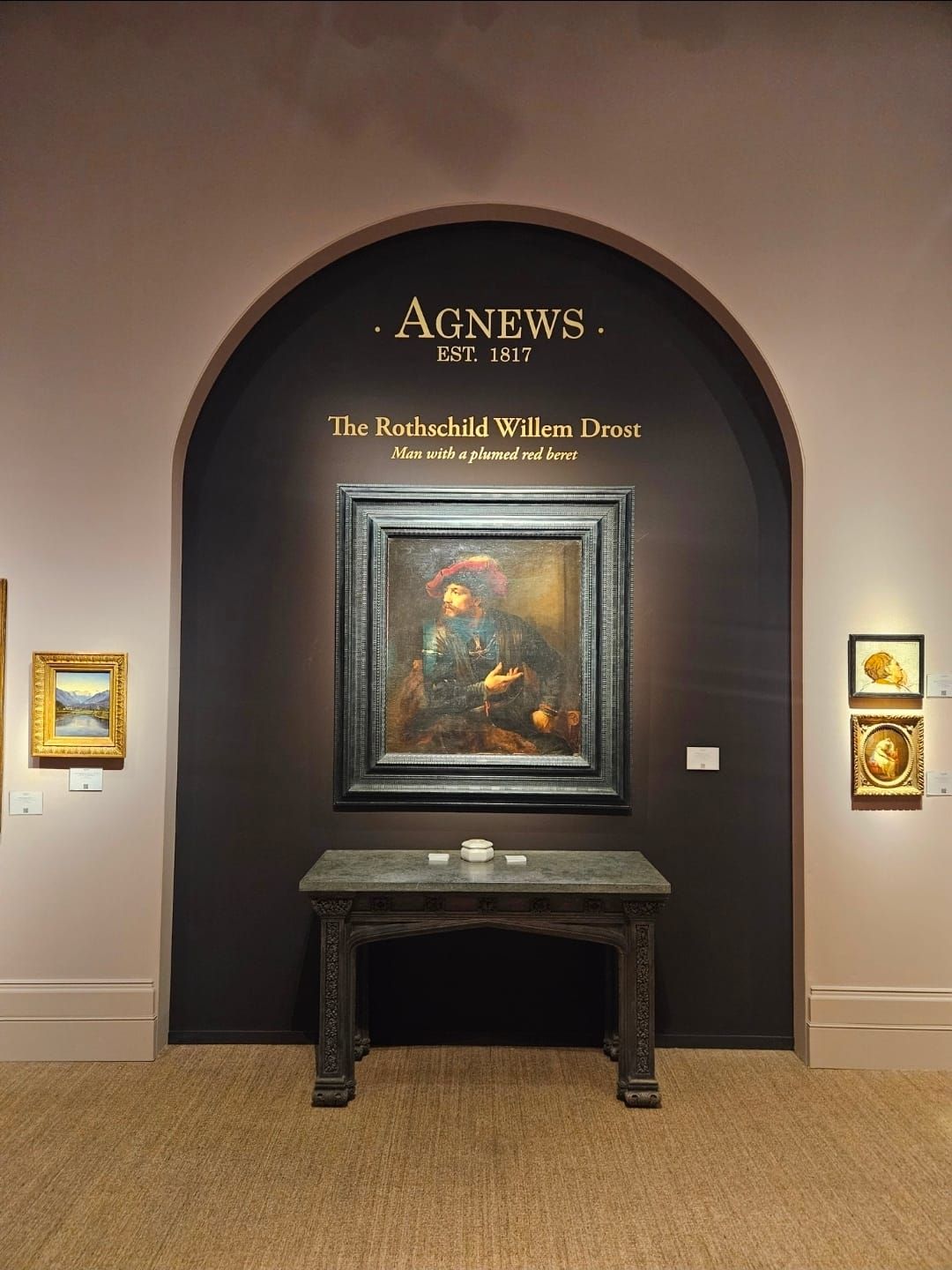
Agnews was just as strong elsewhere. The Willem Drost, Man with a plumed red beret, dated 1654, had the kind of presence that does not depend on noise. Drost remains one of those painters who are perpetually discussed in relation to Rembrandt, yet a work like this reminds you that the point is not only proximity to a master. It is the independent intelligence of the painting itself: the theatrical red beret, the inward turn of the face, the hand suspended mid-thought. The label identified it as signed and dated, and that combination of rarity, quality and personality made it one of the booth’s quiet coups. Meanwhile, Agnews Brussels also had what for Spilliaert collectors felt like a near-historic event: an almost unseen portrait, the kind of work that rarely circulates because the best examples are already locked into museums and major collections.
Another of my highlights was at David Tunick. His stand included Amedeo Modigliani’s Red Caryatid on a Black Ground, circa 1913–14, a gouache and charcoal work that belongs to the period when Modigliani still imagined himself fundamentally as a sculptor. That matters, because the caryatid drawings are not side notes to the career; they are the laboratory where his sculptural thinking, his stylization of the body, and his archaic vocabulary all come together. On the stand, the work looked both forceful and strangely unresolved, which is perhaps why it stayed in the mind. It had mystery without vagueness.
And then there was the Artemisia. The gallery is Robilant+Voena — the “R+V” on the label — and the painting was The Penitent Magdalene, dated circa 1625–30. That alone would be enough to stop people. But what made it memorable was the restraint of the picture: not the Artemisia of maximum violence or courtroom legend, but of inwardness, flesh, fabric, weight, and emotional compression. Robilant+Voena’s presentation at TEFAF this year ranged broadly across periods, but this was one of the works that best justified the fair’s continued authority. It was not just expensive-looking. It was exact.
So yes, TEFAF remains a fair of masterpieces, but that phrase can sound empty if one does not say what kind of masterpieces the market is now rewarding. Increasingly, it is not only the instantly legible trophy lot. It is the work that can survive scrutiny: technically, historically, visually. The Instagram age has not killed connoisseurship. It has made serious objects more valuable, because they now have to perform twice — once in person, and once under the harsher light of constant circulation.
That, to me, was the real lesson of Maastricht this year. Not that art makes people forget the world in crisis, but that the best works — and the best dealers — now succeed by offering something rarer than distraction: conviction.